How to Choose an AI Chatbot Development Company in India (2026)
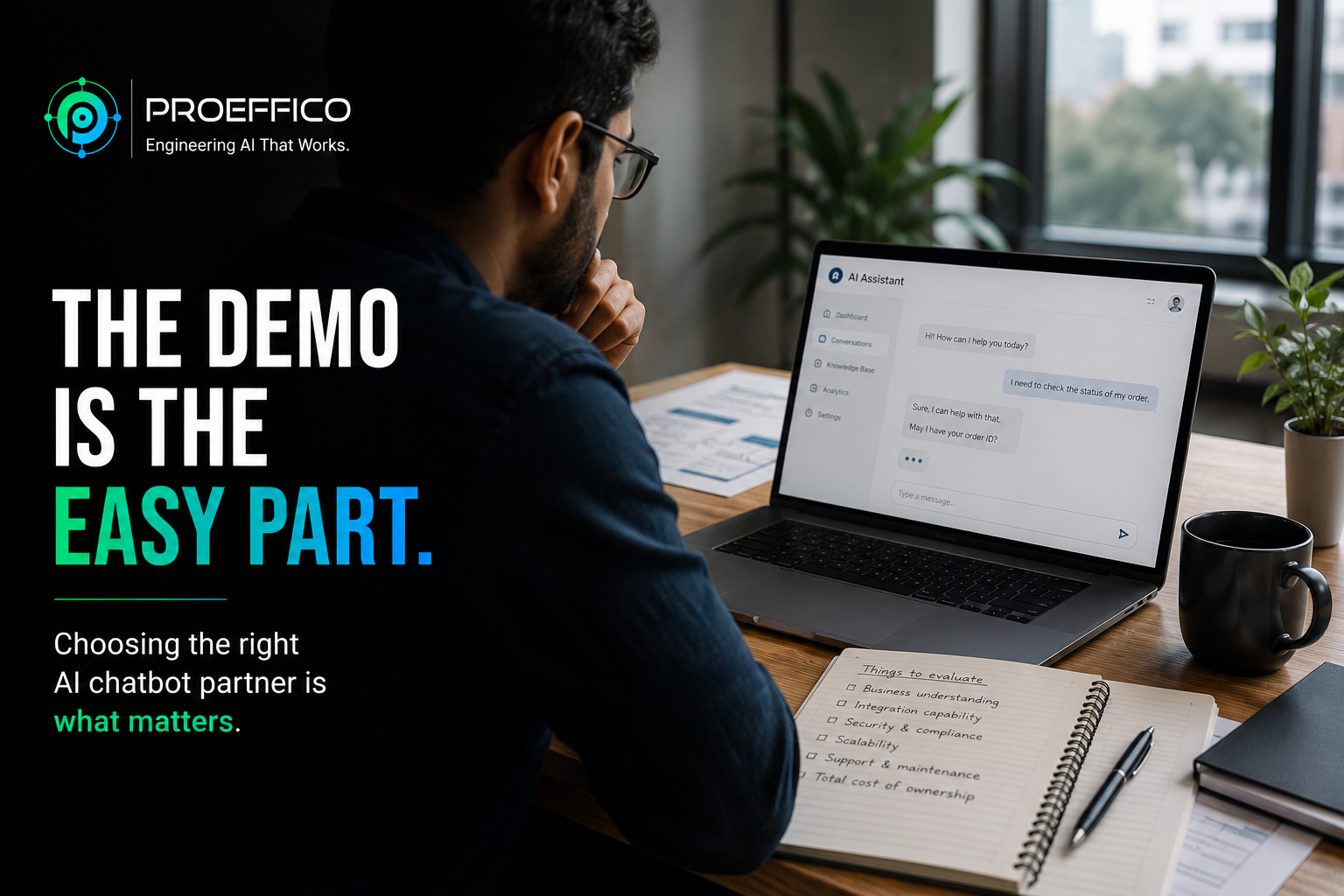
How to Choose an AI Chatbot Development Company in India (2026)
Most "AI chatbot" pitches sound identical: a bot that understands natural language, resolves queries instantly, and cuts support costs. The gap shows up after signing - when the bot can't answer a question outside its training data, can't talk to the CRM, or takes six weeks longer to ship than promised. Choosing an AI chatbot development company in India in 2026 is less about who has the flashiest demo and more about who can scope the problem correctly, integrate with what you already run, and hand over something your team can actually maintain.
This guide is a practical checklist, built from work across manufacturing, BFSI (banking, financial services and insurance), retail, and professional-services clients - covering what "AI chatbot" actually means today, where it earns its cost back, how integration decides whether it gets used, and the questions worth asking before a vendor gets your data.
What "AI chatbot" really covers in 2026
"Chatbot" is now an umbrella term for at least three different things, and vendors don't always volunteer which one they're proposing.
- Rule-based / decision-tree bots - a fixed set of buttons and scripted replies. Cheap, predictable, but brittle outside their scripted paths. Fine for a simple FAQ widget, wrong for anything customers phrase differently each time.
- NLP-driven bots - NLP (natural language processing) lets the bot understand intent and pull the right scripted response, even when the wording varies. Better coverage than pure rule-based, still bounded by what it was trained to recognise.
- LLM-based conversational agents - built on a large language model (LLM), the technology behind tools like ChatGPT and Claude. These can hold a genuine conversation, summarise, and reason over documents, usually paired with retrieval (fetching the right internal document or record before answering) so the bot answers from your actual data instead of guessing.
Most serious 2026 deployments are hybrid: an LLM for understanding and conversation, wrapped in guardrails - defined intents, escalation rules, approved data sources - so it doesn't wander off-script with a customer or an employee. A vendor who can't explain which of these three they're building, and why, hasn't scoped your problem yet.
Use cases that pay off
Not every chatbot idea is worth building. The ones that consistently earn their cost share a pattern: high query volume, a repeatable question structure, and a clear source of truth to answer from.
Proeffico has built this pattern for a large FMCG (fast-moving consumer goods) company with a distributed field sales force that couldn't get daily sales targets to hundreds of reps reliably - internal apps and email had low adoption. The fix was a WhatsApp bot, because reps already lived on WhatsApp: every morning it delivers personalised, SKU-level targets and generates reports on demand, with no manual compilation. Engagement went up simply because the channel matched existing behaviour rather than asking people to adopt a new one.
A different pattern showed up for a professional accounting body's regional chapter, where members needed fast, accurate guidance on a detailed code of ethics - previously a query answered in days by staff who couldn't scale with demand. An LLM-based chatbot trained on that specific reference material now resolves the same queries in seconds, 24/7, without staff needing to be on call for every question.
The common thread: both bots answer a narrow, well-defined question set from a known source of truth. That's where chatbots pay off - customer support triage, lead qualification, HR and IT helpdesk queries, order status, policy or compliance Q&A. An open-ended "ask me anything" bot with no defined scope is usually where budgets go to die.
Integration (WhatsApp, CRM, web)
A chatbot that isn't connected to where your customers and data already are will get ignored, however good the model behind it is. Three integration points matter most for Indian businesses.
WhatsApp. For India, this is often the primary channel, not an add-on. The WhatsApp Business API (the official, paid channel for businesses to message customers at scale, distinct from the free consumer app) is what allows a bot to send proactive messages, handle templated notifications, and hold two-way conversations within Meta's policy limits. If your evaluation doesn't include a straight answer on WhatsApp Business API access and message-template approval timelines, keep asking - see our guide on choosing a WhatsApp Business API provider in India for what to check before you commit.
CRM and internal systems. A support or sales bot is only useful if it can read and write to your CRM, ticketing tool, or ERP - pulling order history, updating a lead record, or opening a ticket instead of just repeating "please contact support." This is systems-integration work as much as it is AI work, and it's usually where timelines slip if the vendor hasn't done it before.
Web and app widgets. Still relevant for website support and lead capture, but in 2026 it's rarely the only channel worth building for an Indian business - it needs to work alongside WhatsApp, not instead of it.
Security and data handling
A chatbot that touches customer data, employee records, or financial queries is a data-handling system first and a conversational interface second. Ask about this before the demo, not after the contract.
At minimum, confirm: where conversation data is stored and for how long; whether the vendor is ISO 27001 certified (the international standard for information security management - Proeffico is) or can show equivalent controls; how personally identifiable information is masked or excluded from model prompts; and whether the bot escalates to a human for anything sensitive rather than guessing an answer.
For LLM-based bots specifically, ask whether responses are grounded in retrieval from your approved documents (often called RAG - retrieval-augmented generation) or generated freely. Free generation risks hallucination - confident, wrong answers - which is a real problem in regulated contexts like BFSI or healthcare. Our piece on AI in banking and BFSI in India covers this in more depth for regulated environments where an ungrounded answer isn't just embarrassing, it's a compliance risk.
Questions to ask
A short, direct list to run through with any shortlisted vendor:
- Which architecture are you proposing, and why - rule-based, NLP, or LLM-based, and what happens when the bot doesn't know the answer?
- Can you show a live deployment for a comparable use case? Not a generic demo - a bot doing the specific job you need done.
- What's the integration scope, and who owns the WhatsApp Business API account, CRM connectors, and any ERP touchpoints?
- How is data handled - storage location, retention, PII masking, and certifications?
- What's the post-launch plan? A chatbot isn't a one-time build; conversation logs need review, intents need retraining, and edge cases will surface in month two that no one predicted in the pilot.
- How is pricing structured - fixed development cost, per-session, per-seat, or a mix - and what's included after go-live?
Vendors who answer these specifically, with examples, are usually the ones who've actually shipped a few of these. Vendors who redirect to a generic capabilities deck haven't. For a broader view of where automation projects like this fit into a larger operations picture, see business process automation for Indian enterprises, and if the use case leans toward physical operations rather than conversation, computer vision development companies in India covers the equivalent evaluation for vision-based AI.
Frequently Asked Questions
How much does it cost to build an AI chatbot in India?
It depends heavily on architecture and integration scope - a scripted FAQ widget costs far less than an LLM-based bot integrated with CRM, WhatsApp Business API, and internal data sources. Get a scoped quote against your specific use case rather than a generic number, since integration work usually drives cost more than the model itself.
Is a chatbot the same as an AI agent?
Not quite. A chatbot is a conversational interface - it answers questions and holds a dialogue. An AI agent typically goes further, taking actions on your systems (updating a record, triggering a workflow) based on that conversation. Many 2026 "chatbot" projects are really agent projects once you scope the integrations, which is why the vendor's integration experience matters as much as their conversational AI experience.
Do I need a large language model for my chatbot, or will rule-based work?
If your queries are narrow and predictable (order status, store hours, simple FAQs), a rule-based or NLP bot is cheaper and more predictable. If queries vary widely in phrasing or require reasoning over documents, an LLM-based approach with retrieval from your own data source will perform better and needs less manual scripting to maintain.
How do I make sure the chatbot works well on WhatsApp?
You need access to the WhatsApp Business API (not the free consumer app), approved message templates for proactive notifications, and a vendor who has actually built and launched a WhatsApp Business API integration before - not just a website widget with a WhatsApp icon.
What security certifications should an AI chatbot vendor have?
At minimum, ask about ISO 27001 certification (information security management) and get specifics on data storage location, retention period, and how personally identifiable information is handled in prompts and logs - especially for BFSI, healthcare, or any regulated use case.
If you're evaluating vendors for an AI chatbot development company in India and want a scoping conversation grounded in what's actually been built and shipped, book a discovery call with Proeffico.