Custom Software vs Off-the-Shelf: How to Decide (2026)
Custom Software vs Off-the-Shelf: How to Decide (2026)
Every growing business eventually hits this question: do we buy something that already exists, or do we build something that fits us exactly? It usually surfaces at an uncomfortable moment — a spreadsheet that's outgrown its owner, a SaaS (software as a service, meaning software you rent and access online rather than install) tool that almost does what you need but not quite, or a process so specific to your business that no off-the-shelf product was ever built for it.
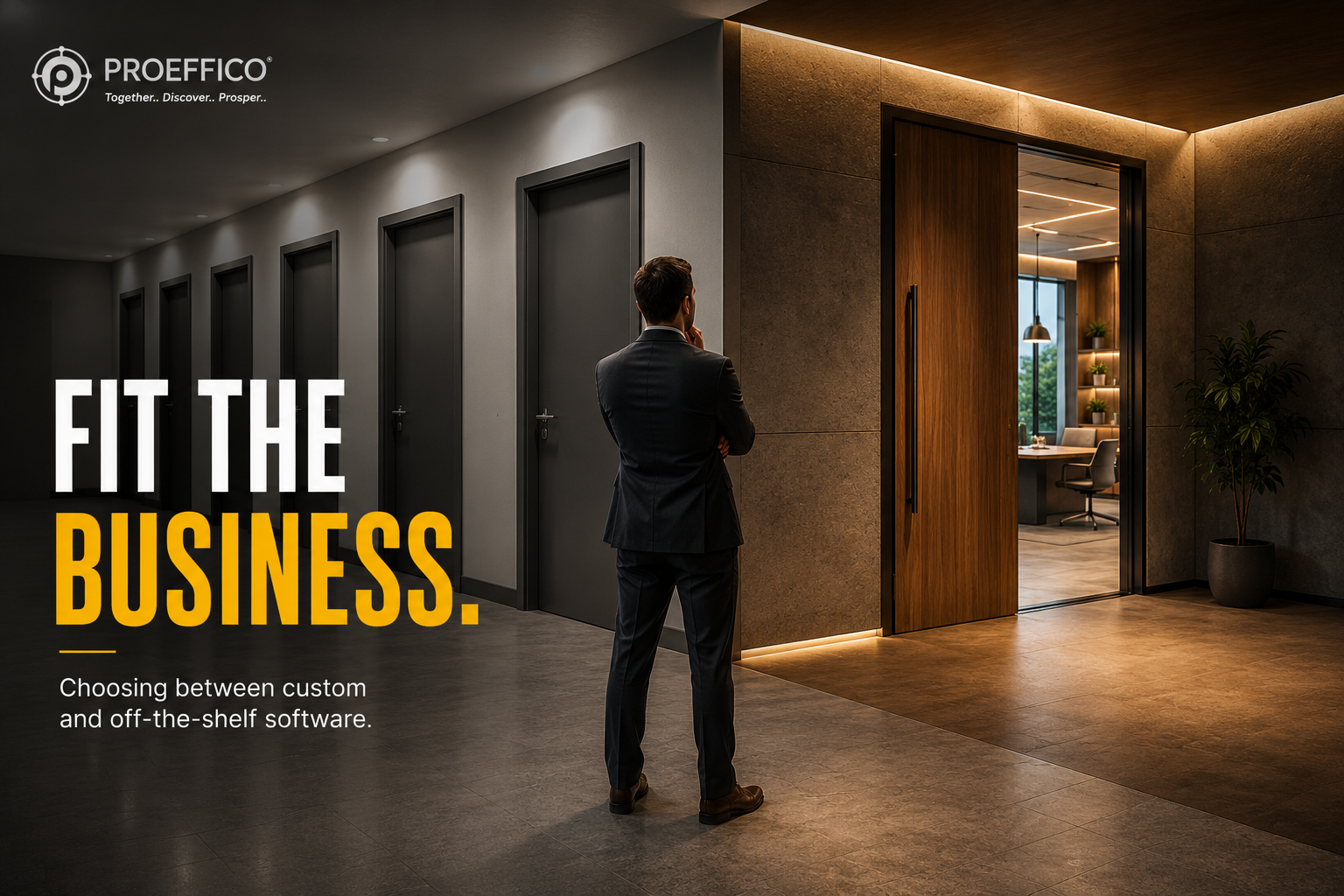
The honest answer is that "custom software vs off-the-shelf" isn't a debate with a universal winner. It's a decision that depends on how standard your process actually is, how much you're willing to pay over time, and how much control you need over the system running your business. This guide walks through that decision the way we walk clients through it — starting with the trade-off itself, not the marketing pitch for either side.
The real trade-off
Off-the-shelf software is built once and sold to thousands of businesses. That's exactly why it's affordable and quick to deploy — the cost of building it is spread across every customer. But it also means the product reflects an average use case, not your use case. You adapt your workflow to fit the software, not the other way around.
Custom software is built once, for one business, around the workflow that business actually runs. That's why it's slower and costs more upfront. But nothing about it is generic — every screen, every report, every automation matches how your team actually works, not how a product manager three years ago imagined a "typical" business like yours would work.
The trade-off, stripped of sales language, is this: off-the-shelf buys you speed and low upfront cost in exchange for fitting your business into someone else's mould. Custom buys you exact fit and long-term control in exchange for a longer build and a bigger initial investment. Neither is inherently right. The question is which cost your business can actually absorb.
When off-the-shelf wins
Off-the-shelf is usually the right call when the process you're digitising is genuinely standard. Accounting, basic CRM (customer relationship management — the system that tracks leads, customers and follow-ups), HR attendance, email marketing — these are problems thousands of businesses share in nearly identical form, and mature products exist because the category has been solved many times over.
It also wins when speed matters more than perfect fit. A 20-person business that needs to stop losing leads in WhatsApp chats and spreadsheets this month doesn't need a six-month build — it needs a working CRM by next week. That's the exact reasoning behind why Proeffico built ZIVUX as an off-the-shelf, subscription CRM rather than a bespoke build for every SME client: most small businesses don't need a custom lead-management system, they need a good one, fast, at a price that doesn't require a board decision.
Budget discipline matters here too. If your process is standard and your team is small, paying a monthly subscription for a maintained, continuously updated product is almost always cheaper than owning and maintaining custom code — at least until the business (or the process) outgrows what the product was designed to do.
When custom pays off
Custom software earns its cost when the workflow you're trying to solve is the thing that actually differentiates your business — not a shared, solved problem, but your specific operational reality.
Take a multi-store retail chain we've worked with: stock was spread across outlets, tracked through disconnected spreadsheets and phone calls, with no single view of what was selling, expiring, or running low. No off-the-shelf inventory tool matched how that specific chain moved stock between stores, how its delivery staff needed live updates, or how its managers needed to see restocking signals before a shelf actually went empty. The fix wasn't a better generic tool — it was a purpose-built platform: a centralised web system for stock visibility across every outlet, paired with a mobile app for delivery staff and managers, with automated order and delivery workflows replacing the manual handoffs entirely.
The same logic played out with an AC dealer whose leads were arriving through phone calls, forms, emails and walk-ins with no single system catching them, and whose quotations were still built manually from outdated templates. A generic CRM could have captured leads. It couldn't have connected that lead capture directly to live inventory and a real-time dispatch tracker in the exact sequence that dealer's sales cycle required. That connective layer — the part that made sales, stock and delivery operate as one workflow instead of three disconnected ones — is what custom development is actually for.
A general rule: if you can describe your process in one sentence that also describes hundreds of other businesses, buy. If describing your process requires explaining three exceptions and a workaround your team invented two years ago, that's a signal custom development is worth pricing out.
Total cost of ownership
The upfront price tag is the least useful number in this decision. What matters is total cost of ownership (TCO) — everything you'll spend over the software's working life, not just what you pay to get started.
Off-the-shelf TCO includes the subscription fee, but also the cost of workarounds — the spreadsheets and manual steps businesses build around a product's gaps, and the staff hours spent maintaining them. It includes per-seat pricing that climbs as you add people, and the switching cost if the product is eventually abandoned for something that fits better.
Custom software TCO includes the build cost, but also hosting, maintenance, and the team or partner who keeps it updated as your business changes. The often-missed line item is change cost: when your process shifts, off-the-shelf products update on the vendor's roadmap (or don't), while custom systems can be modified on your timeline — at a cost, but without waiting on someone else's product priorities.
A useful gut-check: if you'd need to pay for three or four "power-up" add-ons or a higher pricing tier just to make an off-the-shelf product do what your business actually needs, run the TCO math against a custom build before assuming the subscription is cheaper. It often isn't, once you count what you're paying to work around it.
A decision framework
Rather than debating in the abstract, run your specific situation through four questions:
- Is this process standard across your industry, or specific to how you operate? Standard leans off-the-shelf. Specific leans custom.
- What happens if the product changes without you? If a vendor's roadmap shift could break something critical to your operations, that's a control argument for custom — or at minimum, for negotiating source-code or export guarantees.
- What's the real cost of the workarounds you're already living with? Add up the manual hours, the duplicate data entry, the reports someone builds by hand every week. That number is your current TCO for "no system" or "wrong system."
- Can a hybrid actually solve this? Many businesses don't need pure custom or pure off-the-shelf — they need an off-the-shelf core (accounting, ERP such as ERPNext) with a custom layer bolted on for the one workflow that's genuinely unique to them. That's frequently the most cost-efficient answer, and it's how several of the engagements above were actually built — an existing POS or CRM core, extended with the specific automation the business couldn't buy anywhere.
If you're still unsure after answering those four honestly, that's usually a sign the decision needs a proper scoping conversation rather than a guess — because the cost of guessing wrong (a custom build for a standard problem, or an off-the-shelf product stretched past its limits) is measured in months, not rupees.
Frequently Asked Questions
Is custom software always more expensive than off-the-shelf?
Upfront, almost always yes. Over three to five years, it depends on your total cost of ownership — including the workaround costs and add-on fees that off-the-shelf products often carry once you factor in what they don't do out of the box.
Can I start with off-the-shelf and move to custom later?
Yes, and it's a common, sensible path. Many businesses start on a subscription product to move fast, then commission a custom build once they've confirmed exactly which workflow the standard product can't handle — the requirements are clearer by then, which also makes the custom build more accurate.
What is a hybrid approach and when does it make sense?
A hybrid keeps a proven off-the-shelf core — an ERP (enterprise resource planning system), accounting tool, or CRM — and adds a custom layer for the one process that's genuinely unique to the business. It's often the most cost-efficient option because you're not rebuilding what already works well elsewhere.
How long does a custom software build typically take?
It depends entirely on scope. Well-scoped projects with a phased rollout tend to move faster and surface fewer surprises than "big bang" builds that try to launch everything at once.
Who owns the custom software once it's built?
This should be settled in the contract before development starts — typically the client owns the source code and data, while the development partner may retain rights to reusable components or frameworks. Always confirm ownership terms in writing.
If your business has outgrown what off-the-shelf products can offer, or you're not sure which side of this decision you're on, to book a discovery call and get a straight answer on fit, cost and timeline before you commit either way.