Custom AI Software vs SaaS: What Indian Businesses Get Wrong
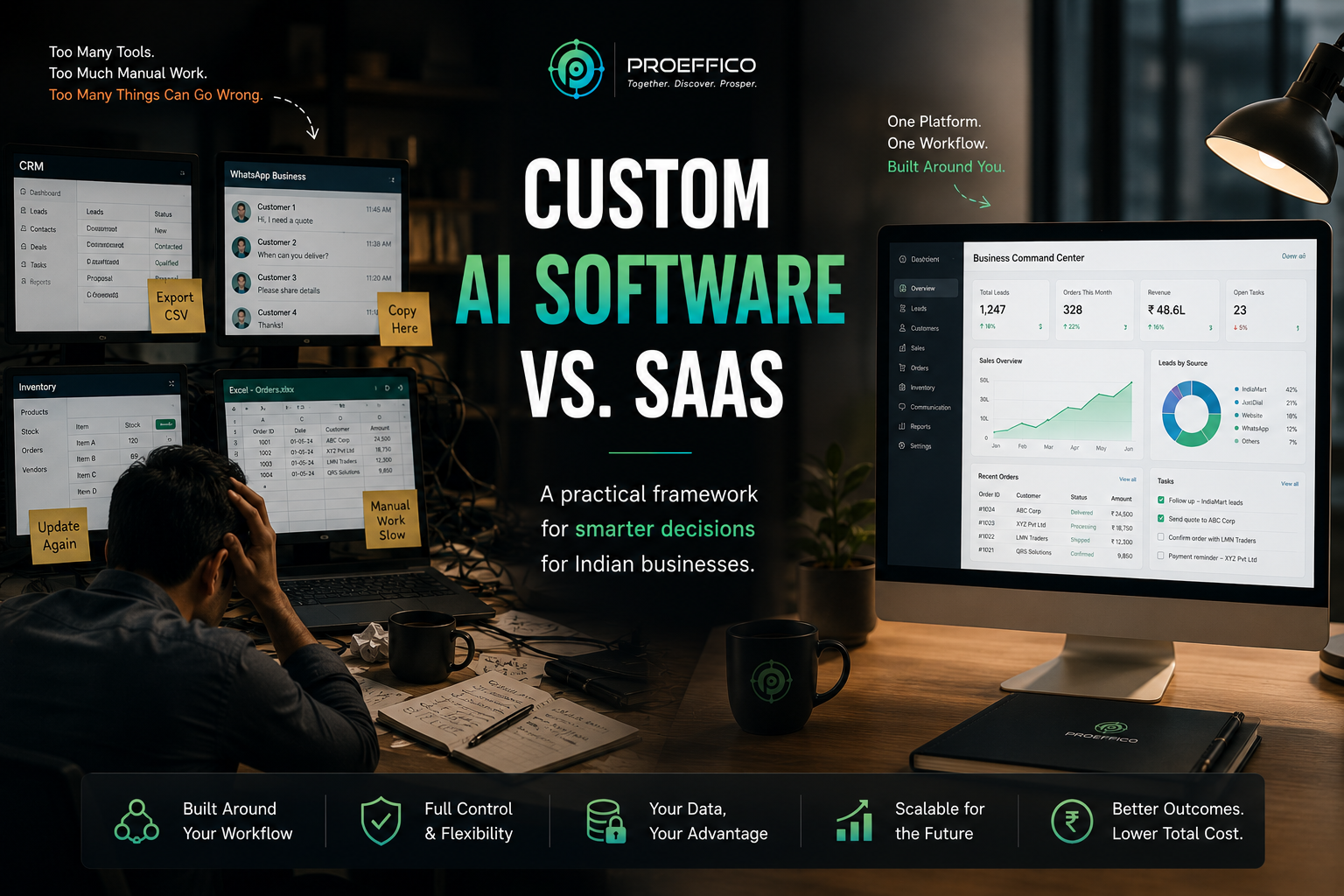
Most Indian businesses arrive at the build-vs-buy question the same way: they have subscribed to three or four SaaS tools, each promised to simplify operations, and now their team spends half the day copying data between them. The tools are not bad. They just were not designed for your approval hierarchy, your vendor terms, or your sales process built on IndiaMart and JustDial leads.
The question is not "is custom AI software India better than SaaS?" It is more precise than that: which path solves your specific problem without creating new ones? This post gives you a working framework to answer it honestly.
The SaaS Promise vs. the SaaS Reality for Indian Businesses
SaaS platforms are engineered to work adequately for the largest possible customer base. That is both their business model and their constraint. A CRM built for a 500-person US sales team will have email drip sequences, deal pipelines, and Salesforce integrations — and it will have none of the WhatsApp-native workflows, IndiaMart lead capture, or multi-owner approval chains that a 25-person Indian distributor runs on every day.
This is not a complaint about software quality. It is a structural reality: a platform optimised for everyone is optimised for no one in particular. The Indian business context adds another layer. Data residency rules, on-premise requirements for sensitive records, compliance with local tax structures, and workflows shaped by relationship-led sales — none of these are designed into a generic SaaS product's default configuration.
Industry data from Retool's Build vs Buy survey directionally confirms that a growing share of enterprises — roughly one in three by some estimates — have already replaced generic SaaS with custom-built internal tooling, specifically because the SaaS stack stopped scaling with their operational needs. The trend is more acute in India, where the mismatch between US-built SaaS and local business process is wider.
Where SaaS AI Genuinely Works Well
SaaS is not the wrong answer. It is the wrong answer for the wrong problem. Here are the situations where a SaaS tool is the right call, and Proeffico would tell you to use one:
- Early-stage companies with no entrenched processes. If you are building your workflows from scratch, a SaaS product's defaults are a good starting point. You have not yet developed the proprietary process that is worth encoding in custom software.
- Standard, generic functions. Email automation, basic CRM for a small team, calendar scheduling, document signing — these are solved problems. A SaaS tool does them reliably and cheaply. A custom build adds cost and maintenance overhead with no competitive return.
- When speed to deploy is the actual requirement. A pilot that needs to be live in two weeks cannot wait for a custom build. A SaaS subscription gets you moving. The question is whether that pilot reveals a deeper need.
The honest answer: start with SaaS, but watch for the signals that tell you it has stopped being enough.
The Four Signals That Tell You SaaS Is Not Enough
These four patterns show up consistently before a business makes the switch to custom AI software development services:
- You are paying for five tools that do not talk to each other. When your billing data lives in one platform, your customer records in another, your field team reports in a third, and your accounts team uses a spreadsheet to reconcile all three — you are not running a SaaS stack. You are running a fragmentation problem with a monthly subscription attached to it.
- Your team maintains manual bridges. If a person's job involves exporting a CSV from one system and importing it into another, or sending a WhatsApp message to "update" a system that cannot receive the input directly — that manual bridge is a risk, a delay, and a real cost. It also signals that the SaaS tools were not designed for your workflow; your team adapted themselves to fit the tool, not the other way around.
- Your competitive edge lives in a process generic software cannot mirror. Your pricing logic, your approval hierarchy, your supplier relationships, your specific quality-check rules — these are the processes that differentiate you from competitors. If a SaaS tool forces you to standardise them out, you are not just buying software. You are giving up operational advantage to fit a platform's model.
- Sensitive data cannot leave your environment. Patient records, financial transaction logs, biometric data, surveillance footage — there are categories of data that cannot move through a third-party cloud under Indian data protection requirements or your own contractual obligations. If your use case involves any of these, an on-premise or private-cloud deployment is not a preference. It is a requirement, and most SaaS tools cannot meet it.
The Real Cost of Custom AI Software in India
The biggest misconception is that custom AI development means an 18-month project and a budget only an enterprise can carry. AI-assisted development has fundamentally changed both timelines and costs. A well-scoped custom build today moves through discovery, a data audit, a proof-of-concept, and initial deployment faster than the equivalent cycle did three years ago.
A realistic cost framework for custom AI software development cost India includes:
- Discovery and data audit — understanding the actual process, the data that feeds it, and the gaps. Skipping this is the most common reason custom builds fail to deliver.
- Proof of concept — a working prototype on your real data, scoped to one process or one location. This is where risk is priced and assumptions are tested.
- Build and integration — the actual development, including connections to your existing systems.
- Deployment and monitoring — going live and maintaining model performance over time.
When evaluating total cost of ownership, compare the custom build against the compounding cost of your current SaaS stack over three years — subscriptions, seat licences, integration middleware, and the hidden cost of the manual work bridging the gaps. The SaaS stack often looks cheaper in year one and more expensive by year three. NASSCOM's SME technology adoption data points directionally to this pattern for Indian mid-market businesses, though the gap varies significantly by industry and workflow complexity.
The Hybrid Path — What Proeffico Recommends
Not every problem needs a full custom build from scratch. Proeffico's own approach follows the Engine + Proof model: when a problem appeared repeatedly across client engagements, we built a product to solve it at scale. That is exactly how ZIVUX, a CRM built specifically for Indian SMEs, came to exist.
Generic CRM tools were not solving the actual lead management problem for Indian distributors and SMEs — they had no native support for IndiaMart and JustDial lead capture, no WhatsApp-native communication layer, and workflows designed for Western sales processes. So Proeffico built ZIVUX not as a feature request but as an answer to a documented, repeated failure of SaaS to fit the Indian context.
The same logic applies to VIZO361 AI video analytics, which exists because generic cloud surveillance SaaS required hardware replacement, lacked on-premise options for sensitive environments, and could not run the specific detection modules Indian manufacturing and retail operations needed on their existing CCTV infrastructure.
Where Proeffico's products fit the problem, they are the faster, lower-risk path than a ground-up custom build. Where they do not, the AI and machine learning development services team builds from the ground up — including custom business process automation for workflows too specific to fit any pre-built product.
A Decision Framework in Three Questions
Before choosing a path, answer these three questions honestly:
- Is this workflow standard, or does it encode your competitive advantage? Standard workflows — payroll, basic invoicing, calendar scheduling — are safe SaaS territory. The moment a workflow is specific to how your business wins deals, manages suppliers, or serves customers, it is a candidate for custom development.
- Can your data stay in a SaaS vendor's cloud, or does compliance or security require you own it? If the answer is "we need to own it," the SaaS conversation ends there. On-premise or private cloud deployment requires a custom or deeply configurable solution.
- What is the three-year cost of the SaaS subscription versus a one-time custom build? Include seat licences, integration middleware, and the fully-loaded cost of the manual work your team currently does to keep the SaaS stack connected. Custom builds are a capital investment; SaaS is an operating cost that compounds. Both can be the right answer depending on your cash position and growth trajectory — but you need to model both honestly before choosing.
If you have answered these three questions and the right path is still unclear, that is exactly what a discovery engagement is designed to surface. The clarity comes from looking at your actual data, your actual process, and your actual cost structure — not from a generic comparison.
Frequently Asked Questions
Is SaaS or custom AI software better for Indian businesses?
Neither is categorically better — the right answer depends on how standard your workflows are. SaaS AI works well for generic, stable functions like basic CRM, email automation, or standard reporting where your processes resemble the majority of the platform's user base. Custom AI software becomes the better choice when your competitive advantage is embedded in a process that no SaaS tool can replicate — your approval hierarchy, your vendor relationships, your India-specific compliance obligations, or your sales workflows built around IndiaMart and JustDial rather than Salesforce defaults. The test is whether the SaaS tool is shaping how you work, or whether your team is constantly adapting to fit the tool's model.
How do I know when I need custom AI software instead of a SaaS tool?
Four signals consistently appear before businesses make the switch to custom AI development. First, you are paying for multiple SaaS tools that do not share data, and your team maintains manual spreadsheet bridges between them. Second, your competitive advantage lives in a process that generic software forces you to simplify or abandon. Third, your data cannot move to a third-party cloud because of regulatory requirements, contractual obligations, or the sensitivity of what it contains — patient records, financial transaction logs, biometric data. Fourth, your SaaS subscriptions are growing with seat counts and feature tiers but the operational problems they were meant to solve have not materially improved.
How much does custom AI software development cost in India?
Custom AI development costs in India depend on scope, data complexity, and how much foundation work is needed before any model can be built. A realistic engagement includes discovery and data audit, a proof of concept on your actual data, the build and integration phase, and deployment with monitoring. The more useful comparison is not day-rate cost but three-year total cost of ownership: SaaS subscriptions compound with seat licences, integration middleware, and feature tier upgrades, while a custom build is a one-time capital investment with predictable maintenance costs. For businesses where the SaaS stack has stopped scaling with operational needs, the TCO calculation frequently favours custom development by year two or three.
What is the hybrid path between SaaS and full custom AI development?
The hybrid path is the most practical answer for many mid-market businesses. Not every problem requires a ground-up custom build — some problems have already been solved and productised by a company that encountered the same recurring gap across multiple client engagements. Proeffico's own products exist because exactly this happened: ZIVUX was built because generic CRM tools had no native support for IndiaMart and JustDial lead capture or WhatsApp-native workflows; VIZO361 was built because cloud surveillance SaaS required hardware replacement and could not run on existing CCTV infrastructure. Where a pre-built product fits the problem, it is faster and lower-risk than a full custom build. Where it does not, custom development is scoped to the specific gap.
Can custom AI software handle India's data residency and compliance requirements?
Custom AI software can be architected specifically to meet India's data residency and compliance requirements — which is one of its core advantages over generic SaaS. Under India's DPDP Act and sector-specific regulations, certain categories of data (patient records, biometric data, financial transaction logs) cannot be sent to foreign-hosted cloud infrastructure without documented safeguards or, in some cases, at all. A custom AI system can be deployed entirely on-premise, in a private cloud within Indian data centres, or in a hybrid configuration that keeps sensitive data local while routing less-sensitive workloads to cloud infrastructure. This architectural flexibility is unavailable in most SaaS products, which use shared infrastructure by default.If you are ready to work through this for your business, book a discovery call with the Proeffico team. We will tell you honestly whether a pre-built product fits, a custom build is justified, or SaaS remains the right answer for where you are right now.
Proeffico builds AI and machine learning development services alongside products — ZIVUX for Indian SME CRM, VIZO361 for AI video analytics on existing CCTV, and MaximPro for multi-outlet retail. Every product started as a custom engagement. That is the Engine + Proof model: services that reveal the ignored problem, products that solve the class of problem at scale.