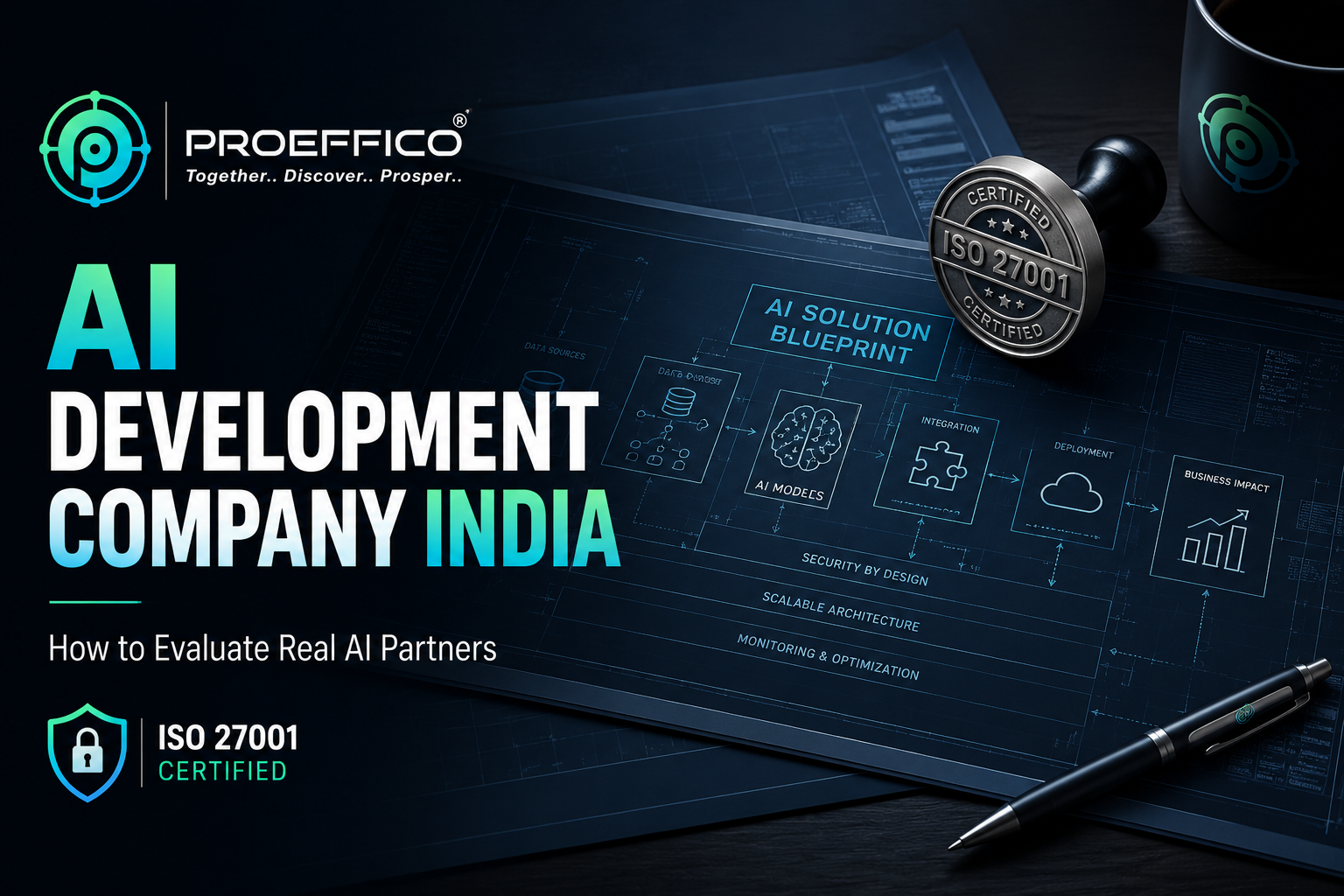
AI Solutions Company in India: What They Actually Deliver
Search for an "AI solutions company in India" and you will find hundreds of results within seconds. Most of them look alike: stock photography of dashboards, a row of partner logos, and a list of capabilities so broad they describe nearly every IT services firm in the country. The vendor hasn't told you what they actually build or who they build it for. That ambiguity is the first thing a serious buyer needs to cut through.
This post is Proeffico's attempt to answer the question honestly — what does an AI solutions company in India actually deliver, how does it work in practice, and how do you know whether the one you're evaluating can solve your specific operational problem.
What "AI Solutions" Actually Means for a Business in 2026
The phrase "AI solutions" covers a wide spectrum, and knowing where on that spectrum a vendor sits is the most important question to answer before you engage them. On one end are pure consulting firms: they will assess your AI readiness, write a strategy document, and hand it back. On the other end are product vendors: they have built a specific application that solves a defined problem, and your job is to fit into their model. In between are custom development companies — engineering firms that will design and build something specific to your operation.
Most Indian IT firms have positioned themselves as all three simultaneously, which is how a company with 30 developers ends up claiming to offer "AI strategy, AI development, AI products, AI training, and managed AI services." That breadth is a warning sign, not a credential.
The mid-market businesses in India that actually get value from AI engagements tend to be working with a narrower, more specific type of partner: one that has already solved a problem in a comparable industry, has a data methodology for determining what is actually buildable given your data state, and has the engineering depth to integrate a new system into an existing technology environment that probably includes legacy software, manual processes, and at least a few critical spreadsheets.
The businesses that don't get value tend to have engaged a vendor who led with a technology — a large language model, a machine learning framework, an AI-enabled SaaS tool — before the problem was properly defined. The technology was fine. The fit to the actual operational problem was not.
The Operational Problems Indian Businesses Are Actually Solving with AI Right Now
These are not aspirational use cases from analyst reports. They are the categories of problems that drive inbound enquiries at Proeffico and that have shaped the AI products we have built for our own customers.
Operational data scattered across disconnected tools. A mid-market manufacturer runs production planning in one system, procurement in another, and quality control in a third. None of them talk to each other. The result is a decision-making process that runs on assembled spreadsheets and WhatsApp messages rather than integrated real-time data. AI built on top of a fragmented data environment will produce fragmented results. The first problem to solve is often not "add AI" but "build a data foundation that AI can trust." Our AI and machine learning development services almost always begin here.
Manual processes that create bottlenecks at scale. Order management, inventory reconciliation, compliance documentation, payroll calculation — these are processes where manual effort creates delays and errors that compound as the business grows. Business process automation services are frequently the right intervention before any machine learning model is introduced. Automating a broken process will produce wrong results faster. Automating a well-defined, correctly structured process reliably frees up operational capacity.
Sales pipelines with no intelligence. Leads enter through multiple channels — IndiaMART, JustDial, WhatsApp, the website — and are manually routed, manually followed up, manually reported. There is no visibility into which leads are progressing, which are stalling, or which channels are generating qualified enquiries versus noise. This is a CRM problem before it is an AI problem, and it is the reason Proeffico built ZIVUX, an AI-powered CRM for Indian SMEs — because no existing tool handled the specific data flows that Indian sales operations actually use.
Security and surveillance data that generates no operational value. A retailer or manufacturing facility runs dozens of cameras 24 hours a day. The footage is stored, reviewed only after an incident, and adds zero value to daily operations. That same infrastructure, with the right AI layer, becomes an operational intelligence system: footfall patterns, staff behaviour, safety compliance, theft detection, vehicle tracking. VIZO361 AI video analytics was built from this exact gap — a services engagement that revealed a surveillance infrastructure producing data no one was using.
HR and payroll data requiring manual reconciliation every cycle. Attendance tracked in one system, leave approvals in another, payroll calculated in a third, and statutory filings managed in a spreadsheet. The reconciliation consumes hours of an HR manager's time each month and introduces error at every transfer point. AI applied to this problem looks like integrated data flows, automated validation checks, and exception-based workflows rather than end-to-end manual review.
How a Real AI Solutions Engagement Works, Step by Step
A realistic AI implementation timeline for a mid-market business in India is 12 to 20 weeks for a first deployment — longer if the data foundation needs work first, shorter if the problem fits a component that already exists. Any vendor who promises a working AI system in four weeks for a genuinely complex operational problem has either misunderstood the problem or is planning to deliver something that will fail quietly six months later.
Phase 1 — Problem framing. This is the step most companies want to skip. "We already know our problem." In almost every engagement, the stated problem and the actual problem differ by the time a rigorous discovery process is complete. Symptoms are not problems. The discovery phase separates the two.
Phase 2 — Data audit. AI requires data. Not just any data — data that is complete, consistent, and structured well enough to train a model or feed an analytical layer. Most mid-market businesses in India discover at this stage that their data is not in the state they assumed. The audit determines what is buildable immediately and what needs to be addressed first.
Phase 3 — Solution design. Three decisions are made here: whether to build a custom model, deploy an existing product, or integrate a platform — or some combination. This is where vendor incentives can misalign with buyer interests. A company that only builds custom will always recommend custom. A company with its own product portfolio will have a reason to recommend its products. The honest answer is sometimes "our existing product solves 80% of this; we build the remaining 20%." That hybrid answer is the one buyers should be pushing for.
Phase 4 — Proof of concept, then controlled rollout, then full deployment. The proof of concept is not a demo. It uses your data and operates against your actual process. The gap between a demo on curated data and a deployment on live operational data is where most AI projects run into trouble. A controlled rollout with a defined set of users surfaces those gaps before they affect the full operation.
Phase 5 — Monitoring and iteration. AI systems degrade when they are not monitored. The model encounters data patterns it wasn't trained on. Operational conditions change. Users find workarounds. The vendor who treats deployment as project completion is the most common failure mode in mid-market AI engagements. Ask directly what the monitoring and iteration structure looks like for the first 90 days after go-live.
Why ISO 27001 Certification Matters When Choosing an AI Solutions Company
AI solutions process data. ERP data, customer data, production records, financial transactions, HR records, surveillance footage. For mid-market businesses that have not historically dealt with enterprise-grade data governance requirements, the risk profile of an AI engagement is easy to underestimate.
ISO 27001 is the international standard for information security management systems. It is not a product certification or a one-time assessment — it is an audited, maintained framework that governs how an organisation manages information security across its processes, technology, and people. A company that has achieved and maintained ISO 27001 certification has had its security posture examined by an external auditor and found to meet defined requirements for data governance, access control, incident management, and risk assessment.
Proeffico has maintained ISO 27001 certification. This matters to a buyer for a straightforward reason: your data, when it moves through an AI development engagement, is as sensitive as your most sensitive operational asset. You should know how it is handled, who has access to it, and what the vendor's incident response process looks like. Ask for the certificate and ask what it covers. If a vendor cannot answer confidently, that is a material concern.
For our enterprise security solutions practice and across our products, the ISO 27001 framework is what governs how client data is handled from the first discovery conversation through to post-deployment monitoring.
Proeffico's Approach — Engine and Proof
The way Proeffico was built is relevant to a buyer evaluating AI solutions companies in India because it explains the credibility claim without requiring you to accept a marketing statement at face value.
The company started inside a pharmaceutical distribution business in India — not as an external consultant studying the problem from the outside, but embedded in the operation, watching the exact friction points that real mid-market businesses deal with: scattered data, manual reconciliation, decisions made on incomplete information because building a better system had been deprioritised in favour of keeping the current one running. That operational experience shaped how the engineering practice was built. AI for manufacturing is one of our strongest practice areas partly because the origin story is operational, not theoretical.
The four live AI products — VIZO361 for video analytics, ZIVUX for CRM, MaximPro for retail chain and POS management, and PROAPP for manufacturing operations — were each built because a services engagement surfaced a problem that no existing product handled well. They are products that run in production, not portfolio pieces.
The services business and the product business are not separate: the services engagements generate the operational intelligence that shapes the products, and the products provide proof that the engineering methodology produces deployable systems, not slide decks. MaximPro AI-powered retail management is a direct example: it emerged from retail operations in India and the GCC and now runs in both markets with full VAT compliance for Oman.
The team of 55 is a deliberate choice — large enough to manage multi-workstream custom engagements, small enough that senior engineers remain directly accountable for delivery quality.
How to Start a Conversation with an AI Solutions Company
Before your first call with any AI solutions vendor, prepare three things.
First, a clear problem description — not "we want to use AI" but a specific operational breakdown: where does your process fail, at what stage, and what does that cost you in time or money? The more specific the problem statement, the faster a genuine solutions company can tell you whether they have solved something comparable before.
Second, a basic data inventory — what data do you have, where is it stored, and how current and complete is it? You do not need to know the answer in detail, but having thought about it will accelerate the discovery process considerably.
Third, clarity on decision-making authority — who in your organisation needs to sign off on an AI engagement, and who will own the implementation on your side? A 16-week project that stalls at week four because the internal sponsor doesn't have budget authority is a waste of everyone's time.
Frequently Asked Questions
What does an AI solutions company in India actually deliver?
An AI solutions company delivers along a spectrum: some offer pure strategy and assessment consulting, others build custom AI systems from the ground up, and others deploy pre-built AI products. The distinction matters because each type has a different cost structure, timeline, and risk profile. Genuine delivery — the kind that changes how a business operates — requires both the engineering capability to build and integrate AI systems and the operational experience to understand which problem is worth solving first. Broad capability claims without live proof of deployed systems are a warning sign, not a credential.
How long does it take to implement AI in a mid-market business?
A realistic first deployment for a mid-market business in India takes 12 to 20 weeks, from problem framing through go-live. This timeline assumes usable data is available. When data quality work is required first — which is common in environments with disconnected ERP, spreadsheet-driven processes, and inconsistent master data — the preparation phase adds four to eight weeks. Any vendor promising a fully functional AI deployment in two to three weeks for a complex operational problem is either simplifying the scope significantly or planning to deliver something that will fail once it encounters real operational data.
What certifications should an AI solutions company have?
ISO 27001 certification is the baseline for any AI solutions company handling enterprise data. The certification requires independent external audit of the company's information security management system — covering data access controls, incident response processes, and risk governance. It is not a one-time assessment; it must be maintained and re-audited periodically. For buyers who will be sharing ERP data, customer records, surveillance footage, or HR data with an AI vendor, ISO 27001 status is a concrete governance signal, not a marketing claim. Proeffico holds this certification across its services and products businesses.
How do AI solutions companies in India differ from enterprise AI vendors?
Enterprise AI vendors typically sell a platform: a configurable SaaS product with AI features that your team adapts to fit your workflows. AI solutions companies build or deploy systems designed around your specific operational problem. For mid-market businesses in India, the distinction is especially significant: enterprise platforms are built for large, stable, homogeneous environments and often require extensive customisation to fit the multi-state compliance requirements, relationship-led sales processes, and mixed data environments that Indian operations run on. The right choice depends on how standard your processes are and whether your competitive advantage lives in a workflow that generic software cannot replicate.
What operational problems are Indian businesses most commonly solving with AI right now?
The highest-frequency problems driving AI engagements at Indian mid-market companies are: operational data scattered across disconnected systems that prevents timely decision-making; manual reconciliation processes in order management, inventory, and payroll that introduce errors and consume disproportionate staff time; sales pipelines with no visibility into lead status across multiple inbound channels; surveillance infrastructure that generates footage no one acts on in real time; and HR and attendance data that requires manual consolidation before each payroll cycle. These problems share a common root: the data to solve them exists in the business, but it is fragmented, poorly governed, or sitting in a system that AI cannot yet access.The right engagement starts with a structured problem conversation, not a product demo. If the company you are evaluating opens with a demo before understanding your problem, that is a signal about how they run their projects. Tell us the operational problem you are trying to solve, and we will tell you honestly whether it maps to something we have solved before and what an engagement would realistically look like.