AI Logistics Automation: How AI is Transforming Supply Chains in 2026
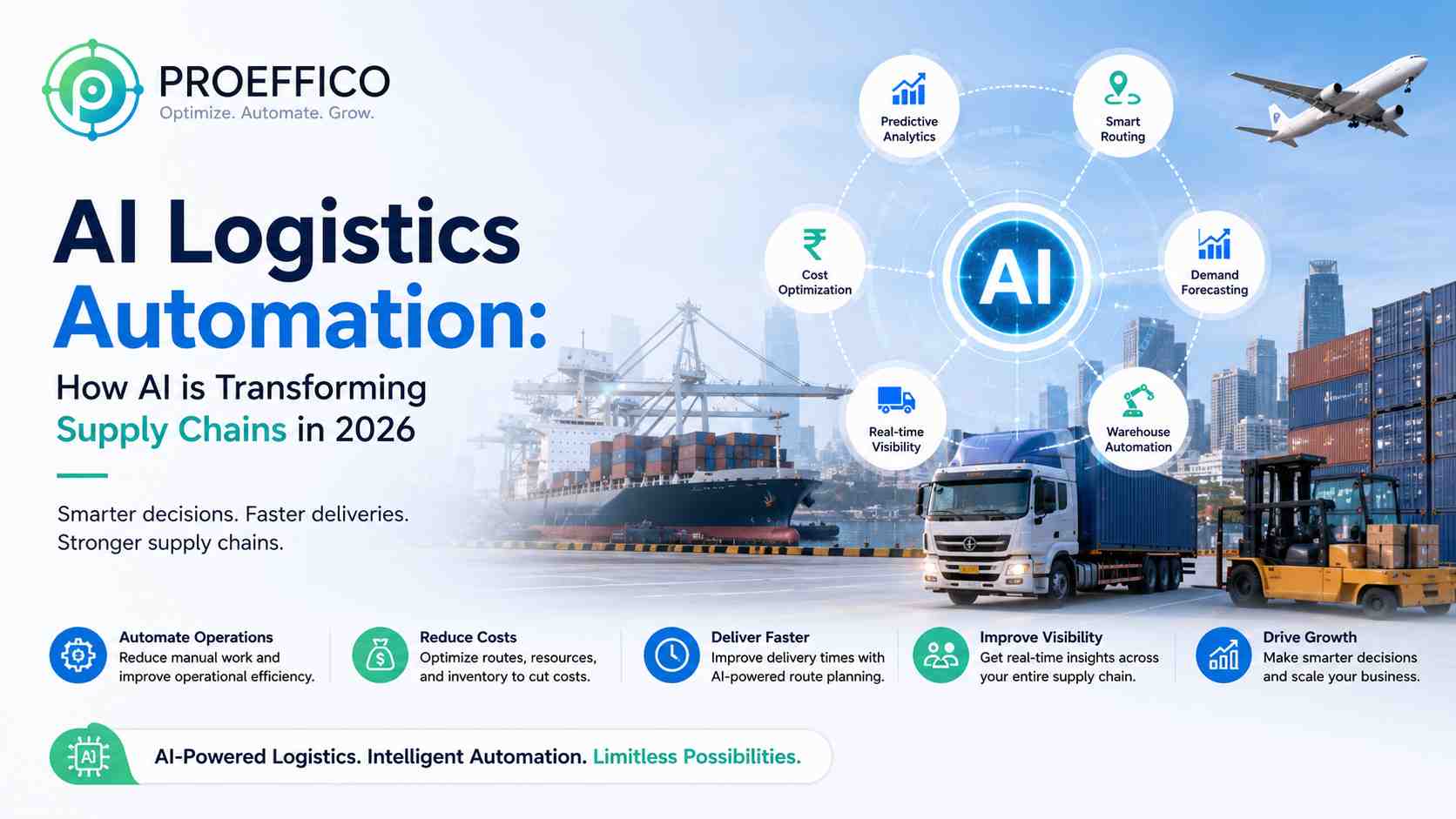
AI Logistics Automation: How AI is Changing the Face of Supply Chains in 2026
Whereas logistics in the year 2026 has undergone a transformation in almost every facet since five years ago, the change seems far from over in what promises to become a revolution in the coming years.
Logistics, it must be admitted, is not an exciting field. It involves missed deadlines, misplaced shipments, and figures that do not tally in spreadsheets. Yet, something unprecedented has happened in the warehouses of 2026 and even the cabs of long-haul trucks. AI logistics automation has done what human effort could never do before.
And India, with its complicated multi-modal cargo system and thriving e-commerce market, looks poised to lead the charge in this revolution.
The Problem in Supply Chain that Nobody Dares Mention
The frustration experienced by all supply chain managers is this – The product leaves the manufacturing plant on schedule, but somewhere along the way, something goes wrong. A customs delay at some point. A missed deadline by a driver in another point. An incorrect inventory figure that is off by 200 products.
These are everyday challenges for a logistic manager.
Traditional logistics optimization software could flag issues, but it couldn’t predict or prevent them. That’s the gap supply chain AI is closing. Modern AI systems don’t just track what’s happening — they anticipate what’s about to go wrong and act before the damage is done.
What AI Logistics Automation Actually Looks Like
Buzzwords have the capacity to make things confusing for many people, therefore here we will make things clearer. This is where AI logistics automation is currently making a tangible difference in the logistics space:
- Demand forecasting – AI algorithms that analyze data such as sales history, meteorological conditions, and social media sentiments to project future requirements.
- Dynamic routing – AI-based fleet management solutions that optimize routes on the basis of live traffic, weather, and delivery priorities, saving costs on fuel while also improving punctuality.
- Automated picking and sorting – Computer-vision-enabled robots that are capable of picking up packages with different shapes, handling fragile items, and working in high SKU environments with no human oversight.
- Supplier risk assessment – AI solutions that assess supplier financial stability, geopolitical happenings, and port congestion to identify potential risks and prevent disruptions.
- Invoice reconciliation – NLP-based tools that are able to reconcile orders to invoices in seconds, tasks that previously took accounts payable teams days to complete.
Warehouse Automation in India: A Market at Inflection Point
Warehouse automation in India is not anymore an experiment carried out only by MNC 3PLs in the country. Economics have changed. Intelligent automation is now much cheaper, whereas the costs of human labor, real estate, and return logistics due to human error have increased.
Indian companies ranging from mid-level D2C brands to large-scale FMCG logistics providers are adopting AI-powered warehouse management systems on a mass scale.
Factors responsible for the trend include the rapid rise of quick-commerce platforms based on 10 to 30-minute delivery times, the growth of organized retail into Tier II and Tier III cities, and the government of India's logistics efficiency mandate as part of its PM Gati Shakti project.
All these factors are creating the need for better efficiency and logistics, making warehouses smart.
What is the result? Warehouses using RFID technology, computer vision, and AMRs are now achieving near-zero picking error rates and utilization above 95 percent — something that was a dream three years ago.
AI Fleet Management: The Road Gets Smarter
Of all the applications of AI fleet management, perhaps none is more visible — or more impactful — than predictive maintenance. Traditional fleets run on fixed service schedules. AI-powered fleets run on sensor data.
Anomalies within the drivetrain vibrations, minor variations in brake pressure, differences in tyre temperatures – all of this data can be used by AI algorithms trained on hundreds of thousands of kilometers of data to predict a malfunction up to two weeks in advance.
In addition to maintenance, AI is revolutionising driver behavior analytics and load optimization. For Indian fleet operators managing hundreds of vehicles across diverse road conditions — from expressways to unpaved village roads — this is a game changer.
Companies that have adopted AI fleet management report a 15–30% reduction in fuel consumption and a meaningful drop in accident rates.
Logistics Optimization Software: Beyond the Dashboard
There’s a generation of logistics optimization software that gave you beautiful dashboards but no power to act on what they showed. The new generation is different.
Today’s platforms combine real-time data ingestion, AI-driven decision engines, and direct integrations with ERP systems, carrier APIs, and IoT devices — so when the system identifies a risk or opportunity, it can execute, not just alert.
Think of it this way: old software told you it was going to rain. New software already booked a covered truck.
At Proeffico, our approach to supply chain intelligence is built around exactly this principle. Our AI agent integrations are designed to sit inside your existing workflows — not replace them — and surface decisions that humans can trust and act on at speed.
Whether it’s PROAPP for manufacturing operations or our custom on-premise LLM deployments for sensitive freight data, the goal is always the same: autonomous operations that make your teams sharper, not redundant.
The Human Side of Automation
The question that pops up frequently is, “Does AI eliminate jobs in logistics?” And the truth behind the question lies in nuance.
Tasks that are repetitive and prone to high error rates are increasingly automated, such as manual data entry, simple sorting processes, and routing planning.
Yet the need for professionals in higher-level positions increases: professionals who supervise AI systems, analyze data, manage exceptions, and support customer experiences through AI technology.
The winners in the talent race in logistics at present are companies that make investments both in automation and skill acquisition because they perceive AI as a partner in the process, not as a replacement.
Supply chain AI doesn’t just cut costs — it builds the kind of resilience that lets businesses grow through disruption rather than being undone by it.
Getting Started: What to Prioritise
If you’re evaluating AI logistics automation for the first time, resist the urge to boil the ocean. Start with the highest-friction, highest-cost problem in your chain.
For most businesses, that’s one of three things:
- Inventory accuracy (the root cause of most fulfilment failures)
- Last-mile delivery costs (typically 40–50% of total logistics spend)
- Demand forecasting errors (which cascade into overstock or stockout disasters)
Pick one. Instrument it properly. Let the data speak. Then scale. That’s not a slow approach — it’s the approach that actually sticks.
Frequently Asked Questions
Q1: Explain the difference between AI logistics automation and conventional logistics software?
AI logistics automation takes the concept of traditional logistics software beyond reporting what happened by learning from past patterns and live data.
It is capable of predicting potential disruptions, optimizing routes, and even executing decisions independently without any human intervention based on historical patterns and current trends.
The key distinction here lies in moving from passive reporting towards proactive decision-making and sometimes complete autonomy.
Q2: Would it make sense for Indian businesses of moderate size to automate warehouses?
Definitely. With the cost coming down drastically over the past few years, there are several warehouse automation services available today, which can be scaled up incrementally.
For instance, one can start off with an automated inventory monitoring or barcode scanning application and gradually move onto using AMRs.
This is now financially feasible even in the mid-size market segment where companies deal with fluctuating demands and large SKUs.
Q3: In what ways does AI-based fleet management enhance delivery operations?
AI-based fleet management solutions rely on telematics information, live traffic data, weather information, and predictive maintenance algorithms to ensure continuous optimisation of delivery routes, driver schedules, and cargo loadings.
The outcomes include less downtime, lower fuel costs, fewer mechanical malfunctions, and improved customer satisfaction.
Modern technology allows for changes in priorities on-the-go based on updated conditions.
Q4: What types of data are required for an effective AI solution within the supply chain domain?
AI solutions within the realm of logistics and the supply chain require both internal data such as order history, inventory data, lead times, and external data including market demand, weather conditions, congestions at ports, commodity prices.
The bright side of the situation is that most companies already collect and store relevant data; the main problem lies in its proper integration.
Q5: How long will it take for me to implement my logistics optimization software?
Implementation takes different periods of time, but most of today’s logistics optimization systems start delivering results in 8-12 weeks from the project start.
The key to a fast and successful implementation is data quality. Clean and integrated data help achieve quick results.
This is why companies that prepare their data prior to implementation have much shorter implementation times.