AI in Healthcare India: Where It Works and Where It Fails
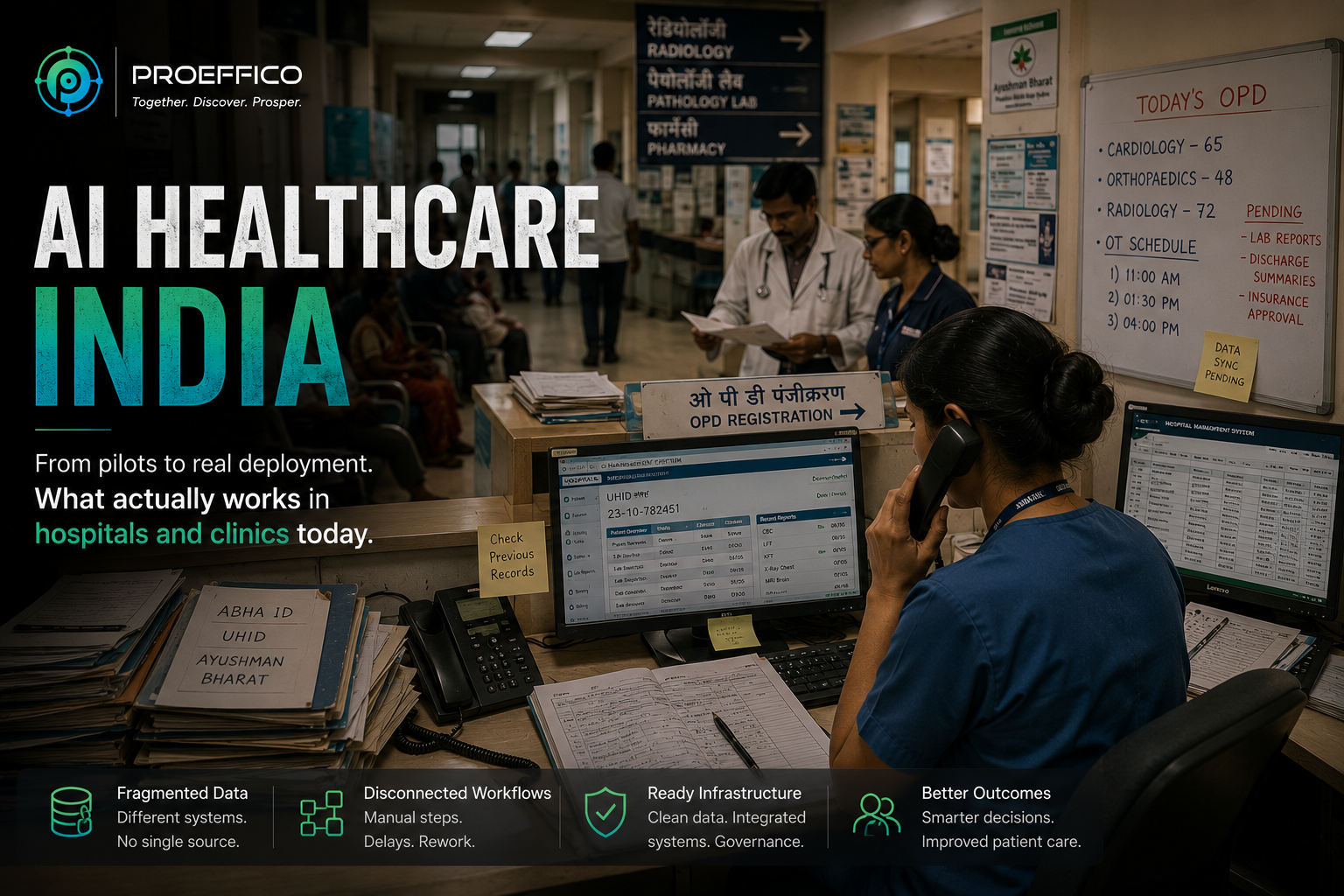
Most conversations about AI in Indian healthcare skip the part that matters most. They talk about diagnostics algorithms, drug discovery timelines, and impressive pilot results — and gloss over the fact that the majority of hospitals attempting AI deployment run into the same wall six months in: their data is fragmented, their workflows are not ready, and the model they've invested in is sitting idle because no one can clean the pipeline underneath it.
This is the conversation worth having. Not whether AI can work in Indian healthcare — the evidence that it can is solid. But what needs to be in place before it will.
Why 2026 Is a Different Moment for AI Healthcare India
For years, the dominant question in Indian healthcare was whether AI was useful at all. That question has been settled. The government's SAHI framework, released in March 2026, is India's first national AI healthcare policy — and its existence signals that the sector has moved from asking whether to governing how.
SAHI rests on five pillars: governance, safe infrastructure, workforce readiness, ethical oversight, and equity-centred deployment. The framework designated AIIMS Delhi, PGIMER, and AIIMS Rishikesh as AI Centres of Excellence, effectively creating a national infrastructure for clinical AI validation. These are not innovation labs. They are intended to be the governance anchors that health systems and AI vendors will need to work through as clinical AI scales.
The scale of the underlying platform is already visible. eSanjeevani, India's government telemedicine system, has recorded 282 million consultations — and AI-assisted triage and routing are part of how that volume is managed. That is not a pilot. That is AI in healthcare at national scale, with real operational proof.
The shift in 2026 is not from nothing to something. It is from "AI as experiment" to "AI as regulated operational infrastructure." For hospital administrators, IT heads, and clinic operations managers evaluating AI today, that shift has a direct implication: the governance and infrastructure questions are no longer optional.
The Six Areas Where AI Is Delivering Real Results in Indian Hospitals
The applications where AI is generating credible, measurable outcomes in Indian healthcare today are specific. Knowing which ones work — and at what level of maturity — is more useful than general optimism about the technology's potential.
AI-assisted diagnostics is the most visible area of progress. Companies like Qure.ai have deployed chest X-ray screening AI at significant scale across TB detection programs, with results demonstrating meaningful improvements in early identification rates. Diabetic retinopathy and eye disease screening are similarly proven ground, particularly for screening in under-resourced settings where specialist access is limited.
Predictive risk stratification — flagging patients at high risk of deterioration before a clinical event — is maturing in tertiary care settings. The challenge is data availability: these models require structured longitudinal data that many hospitals in India are still building the capacity to collect.
Administrative automation is where the near-term ROI is clearest and the risks are lowest. Discharge summary generation, billing code assignment, prior authorization documentation, and appointment scheduling are document-heavy, rule-bound processes that AI handles well — without the clinical validation overhead that diagnostic AI requires. This is where most hospitals should start.
Drug discovery support, primarily literature synthesis and clinical trial matching, is relevant mostly to research institutions and large pharma-adjacent hospital systems. The returns are real but the application set is narrow.
Telemedicine triage and AI-first routing, as eSanjeevani's scale demonstrates, is an established application. The AI components handle initial symptom assessment and specialist routing, reducing the burden on human triage staff while improving first-contact accuracy.
Facility and operations management is the application area that gets the least attention but often delivers the fastest payback. Predictive maintenance for imaging equipment and surgical instruments, medical inventory forecasting, energy management, and infection control monitoring — these are operational intelligence problems, not clinical AI problems. The models are more straightforward, the data is cleaner, and the integration complexity is lower. For a hospital group managing multiple facilities, an AI-driven operations layer can generate measurable cost reductions within a single financial year.
Proeffico's operational intelligence work, including VIZO361 facility monitoring for clinical environments, sits in this last category. AI video analytics applied to access control, equipment placement compliance, and perimeter security is a practical, deployable capability that does not require clinical data or ABDM alignment to deliver value.
The Infrastructure Healthcare Providers Must Have Before AI Can Work
This is where most AI initiatives in Indian healthcare actually fail — not in the model, and not in the vendor relationship. In the data and workflow layer underneath.
The single biggest failure point is fragmented EMR and HIS systems. Indian hospitals frequently run multiple systems that do not communicate: a HIS from one vendor, a laboratory information system from another, radiology PACS from a third, billing in a spreadsheet or a legacy ERP. Patient records are split across systems, duplicated inconsistently, or simply missing. No AI model — however well-designed — can produce reliable outputs from this foundation.
Interoperability is the technical dimension of this problem. India's ABDM framework provides a standards baseline that is worth adopting regardless of any AI initiative, because ABDM-aligned data architecture is the minimum condition for clean input into any AI system. Hospitals that have invested in ABDM compliance have a meaningful head start.
Data residency and security add a regulatory layer that is now non-negotiable. India's DPDP Act governs how patient data can be stored, processed, and accessed. Clinical data regulations add further constraints on what can go to a cloud environment and what must stay on-premise. This is not a theoretical concern — it is an active compliance requirement that shapes every AI architecture decision a hospital makes today. On-premise or private-cloud LLM deployments are increasingly the right answer for document-heavy clinical workflows: discharge summaries, policy queries, patient record synthesis. Privacy is preserved, compliance is maintained, and the capability is real.
Change management is the last-mile problem that no technology solves. Clinical staff adoption is what determines whether an AI tool gets used or quietly abandoned after the pilot. This requires more than training — it requires workflow redesign, with clinical staff involved in shaping how AI recommendations are presented, reviewed, and acted on. A radiologist who trusts an AI screening flag and understands exactly what it means will use it productively. One who receives the same output without context will override it by default.
We have seen the data fragmentation problem in other regulated industries — manufacturing, BFSI, logistics. The shape of the problem is the same in healthcare. The stakes are just higher. Our data analytics and business intelligence practice works with exactly this class of problem: legacy systems that hold valuable operational data, siloed in formats that make it unusable until a proper integration and analytics layer is built over them.
The Risk of Moving Too Fast — What Healthcare Operators Should Know
Clinical AI carries a category of risk that operational AI does not. A billing automation error is correctable. A clinical decision support error can cause harm.
Research published in Nature Medicine found that AI responses in cardiology contexts contained clinically significant errors in approximately 6.5% of cases — a rate that is unacceptable without a mandatory human clinical validation loop. This is not a reason to avoid clinical AI. It is a reason to design the governance architecture first and the model second.
The SAHI framework's emphasis on governance and ethical oversight exists precisely because hallucination risk in clinical settings is qualitatively different from hallucination risk in a customer service chatbot. AI recommendations in diagnostic or clinical decision support contexts must be presented as supporting information for a qualified clinician's judgment — not as conclusions. Any vendor proposing to remove that human review layer should be treated as a red flag, not a differentiator.
The correct framing for AI in healthcare is this: it is an operational and infrastructure engineering problem first, and a model problem second. The models are, in many cases, already good enough. The bottleneck is the data quality, the workflow integration, and the governance structure that makes responsible deployment possible.
Where Proeffico's AI Engineering Applies in Healthcare
Proeffico is not a clinical AI company. We do not develop diagnostic algorithms or clinical decision support models. That boundary is important — and it's the reason we can be useful to healthcare providers in the areas where the actual implementation gaps exist.
The work we do that is directly applicable to healthcare operations falls into four categories.
Operational intelligence and facility monitoring. AI video analytics applied to a hospital or clinic campus — access control to restricted zones, fire and smoke detection, equipment location compliance, perimeter monitoring — is a deployable capability that operates entirely outside the clinical data environment. It runs on existing camera infrastructure without requiring a hardware replacement program. VIZO361's enterprise facility monitoring has been designed for exactly this kind of regulated, security-sensitive environment.
Process automation for administrative workflows. Billing, discharge documentation, procurement approvals, vendor onboarding, HR workflows — these are the operational processes in a hospital that run on document-heavy manual effort. Custom AI development applied to these workflows generates measurable time savings and error reduction without touching clinical data pipelines. This is where the fastest near-term ROI in healthcare AI currently sits.
Data modernization and legacy integration. Many Indian hospitals run HIS and LIS systems from vendors that no longer exist or no longer support integrations. Building a clean analytics layer over that legacy infrastructure — one that consolidates data without requiring a full system replacement — is an engineering problem we approach across multiple industries. Healthcare is not unique in having this problem; it is, however, the industry where solving it most directly enables everything else on the AI roadmap. Our AI integration services cover this integration layer explicitly.
On-premise LLM deployment for document-heavy workflows. For discharge summary generation, clinical guideline queries, and policy document retrieval, a locally-deployed language model — running entirely within the hospital's own infrastructure — provides the productivity benefit of AI without the data residency and compliance risk of sending clinical text to an external API. This is a deployment model that satisfies DPDP Act requirements while delivering genuine workflow improvement for clinical administration staff.
How to Start an AI Engagement in a Healthcare Setting
The answer to where to start is almost always the same: administrative and operational automation first. Lower risk, faster proof, and the implementation generates the clean data infrastructure that clinical AI will need later.
The sequence that tends to work is: operational and administrative automation first, because the data is cleaner and the governance requirements are simpler. Then data foundation work — ABDM alignment, legacy system integration, a clean analytics layer. Then, and only then, clinical decision support — with the proper clinical validation governance in place and qualified clinicians involved in designing how AI outputs are reviewed.
Each stage has to be done properly before the next one can deliver value. Hospitals that skip the data foundation phase to move directly to clinical AI tend to spend significant resources on implementation and get inconsistent results — not because the technology failed, but because the infrastructure it depended on was never built.
The starting question for any healthcare AI evaluation should not be "which AI product should we buy?" It should be: "what is the specific operational or administrative problem that, if solved, would generate visible improvement in how this facility runs?" That question leads to a bounded, solvable first engagement. The more ambitious AI roadmap follows naturally once the foundation is established.
Frequently Asked Questions
How is AI being used in healthcare in India right now?
AI in Indian healthcare is being applied across six substantive areas: AI-assisted diagnostics (particularly chest X-ray screening and diabetic retinopathy detection), predictive risk stratification for early patient deterioration alerts, administrative automation for discharge documentation and billing, drug discovery support for research institutions, telemedicine triage and routing, and facility and operations management for hospital campuses. Of these, administrative automation and operational intelligence typically offer the fastest near-term return on investment because they do not require clinical data validation and can operate independently of the more complex governance requirements that diagnostic AI demands.
What does a hospital need to implement AI successfully?
The most critical prerequisite is a functional data foundation, not a sophisticated model. Hospitals with fragmented EMR and HIS systems — where patient records are split across incompatible platforms, laboratory data cannot communicate with radiology systems, and billing runs from a separate ERP — will find that any AI layer built on top of this fragmentation produces unreliable outputs. ABDM-aligned data architecture provides a practical standards baseline for structuring clinical data. Beyond data, successful implementation requires clear data residency compliance planning under India's DPDP Act and clinical data regulations, and meaningful change management with clinical staff involved in designing how AI outputs are reviewed and acted upon.
Is AI safe to use in clinical settings in Indian hospitals?
Clinical AI carries a different risk profile than operational AI. Research published in Nature Medicine found that AI responses in cardiology contexts contained clinically significant errors in approximately 6.5% of cases — a rate that requires a mandatory human clinical validation loop in any responsible deployment. The government's SAHI framework, released in March 2026, reflects this: its pillars explicitly include ethical oversight and governance requirements precisely because removing human review from clinical decision support creates unacceptable risk. AI in clinical settings should be presented as supporting information for a qualified clinician's judgment, not as a decision-making system. Any vendor proposing to eliminate that review layer is a material red flag.
What is India's SAHI framework and how does it affect hospital AI deployments?
The SAHI (Safe AI for Health in India) framework, released in March 2026, is India's first national AI healthcare policy. It rests on five pillars: governance, safe infrastructure, workforce readiness, ethical oversight, and equity-centred deployment. It designated AIIMS Delhi, PGIMER, and AIIMS Rishikesh as AI Centres of Excellence, creating the national governance infrastructure for clinical AI validation. For hospital administrators and IT heads, SAHI's practical effect is to make governance and infrastructure questions non-optional: AI deployments in clinical settings now have a regulatory framework they must operate within, and building against that framework from the start is less costly than retrofitting compliance after deployment.
Where should a hospital start its AI implementation journey?
The recommended starting point is administrative and operational automation — not clinical AI. Billing automation, discharge summary generation, procurement workflows, and facility monitoring all generate measurable value faster than clinical AI, carry lower governance requirements, and do not depend on the same level of clinical data standardisation. More importantly, implementing these operational layers generates the clean, structured data infrastructure that clinical AI will need later. Hospitals that skip directly to clinical decision support without building the data foundation first consistently experience the same outcome: a model that works well on curated pilot data and performs inconsistently in production, because the underlying data quality was never addressed.If you are evaluating AI for your hospital, clinic group, or healthcare system — start with the problem, not the technology. Our AI solutions for healthcare providers cover the full range of operational, integration, and automation problems that sit between where most health systems are today and where AI can take them. The right place to begin is a structured discovery conversation, not a product demo.