AI Development Company India: The Mid-Market Buyer's Guide
When a mid-market company in India starts evaluating AI development partners, the shortlist process usually looks the same: ten vendor websites with nearly identical claims, a deck full of logos, and a nagging feeling that nobody on the other side has actually solved a problem like yours before. That anxiety is rational. It's also the right place to start this conversation.
Proeffico is an AI development company headquartered in Noida with a 55-person team and ISO 27001 certification. This guide is written from the position of a company that builds AI — and that has watched other companies get burned by partners who couldn't. The questions below are the ones worth asking anyone on your shortlist, including us.
Why India Is the Right Place to Build Custom AI in 2026
India's AI talent pool is genuinely deep, and the cost advantage relative to the US or UK is real. But neither of those facts is the most important reason to build with an Indian AI company. The more relevant reason is proximity to the problem.
India's mid-market businesses operate in conditions that Western enterprise software was never designed for: multi-location operations with inconsistent connectivity, approval hierarchies that no off-the-shelf workflow tool captures, inventory logic that shifts by region and season, and compliance requirements that evolve faster than vendor update cycles. An AI development company that has only built for stable, homogeneous enterprise environments will struggle here.
The companies that figure out AI in Indian mid-market operations — in pharma distribution, manufacturing, multi-outlet retail, logistics — are solving genuinely hard problems. The solutions they build tend to travel well to similar markets in the GCC and Southeast Asia, which is exactly the expansion pattern Proeffico's own products have followed.
India's AI adoption is growing steadily across manufacturing, BFSI, logistics, and healthcare. The buyer's real challenge isn't finding an AI company — there are hundreds now. It's identifying which ones have solved a problem that resembles yours, under real operating conditions, and can prove it.
What an AI Development Company Actually Does (vs. What They Claim)
There's a gap between "we do AI" and "we have deployed AI in your kind of operation." That gap is what the market currently calls the AI-washing problem.
Every IT services firm in India added AI to its pitch in 2023 or 2024. Some of them meant it — they invested in capability, built pilots, got certifications, and accumulated genuine delivery experience. Most didn't. They repackaged existing web development or ERP work with AI language, and the projects that followed were expensive, slow, and underwhelming.
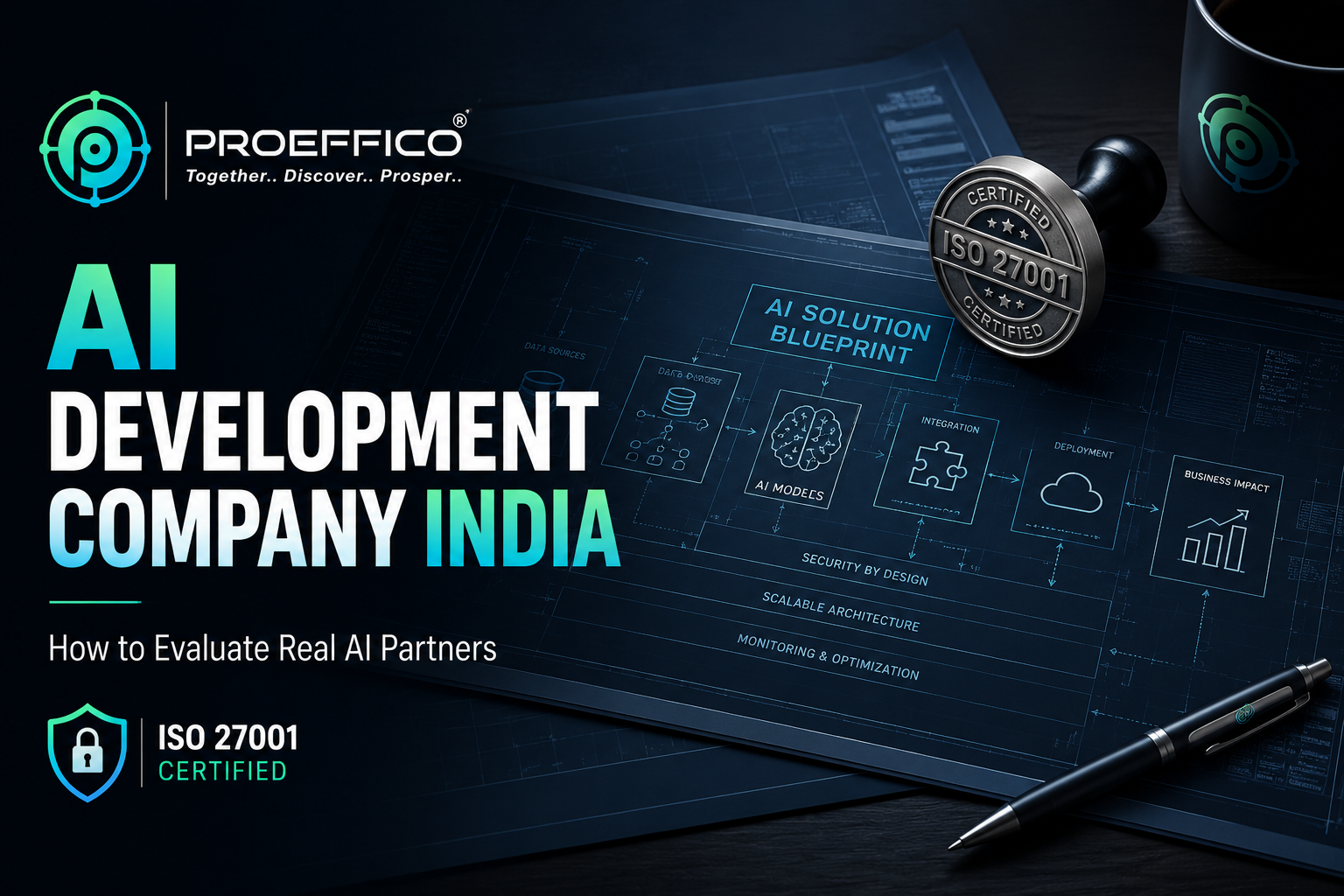
Custom AI development, when it's done properly, follows a sequence that looks nothing like buying a SaaS subscription with an AI feature. It starts with problem discovery: understanding exactly where your operation breaks down, where decisions are made on stale or incomplete information, and where manual effort is filling a gap that a system should cover. Then comes a data audit — because no model works without usable training data, and most mid-market companies discover at this stage that their data is in a worse state than they assumed. Model selection follows, then integration into existing systems, and finally deployment with active monitoring.
That monitoring phase is where many vendors disappear. The post-deployment period — the first 60 to 90 days where the model encounters edge cases it wasn't trained on, where users find friction in the interface, where operational conditions shift — is when a genuine AI development partner earns its value. Ask directly: what does your support look like after go-live?
Our AI and machine learning development services are structured around this full lifecycle, not just the build phase.
Five Questions to Ask Any AI Development Company Before You Sign
These questions come from patterns we've seen in how buyers evaluate AI development partners — including how they've evaluated us.
Do they own proof — a live product, not just client logos? A company that has built and deployed its own AI product has skin in the game. It lives with the consequences of its architecture decisions, user experience choices, and data governance practices. Client logos are curated. A live product is auditable. At Proeffico, we've built four AI products — VIZO361, our AI video analytics product built for retail and manufacturing; ZIVUX, our AI-powered CRM for Indian SMEs; MaximPro, a cloud POS for multi-outlet retail; and PROAPP — each of which emerged from a real services engagement where a client problem revealed a gap that no existing product solved.
Is their work ISO 27001 or equivalent certified? Custom AI development involves handling your operational data — sometimes your customer data, your financial records, your production logs. Data governance isn't a nice-to-have. An ISO 27001 certification means an external auditor has examined the company's information security management system and found it structured and operational. Proeffico has maintained this certification. Not all AI development companies in India have bothered.
Can they show a before/after on a real operational problem? Not a case study written by their marketing team. A specific problem, a specific change to how the operation ran, and a measurable outcome.
Do they stay post-deployment, or vanish after handoff? This is the most important question and the least asked. AI systems behave differently in production than in testing. The model drifts. New data patterns emerge. Users find workarounds that break the logic. A company that treats deployment as the finish line is not a partner; it's a vendor.
Have they solved a problem in your industry before? Industry-specific experience matters not because the technology is different but because the operational context is. Healthcare approvals, manufacturing floor data collection, retail shrinkage patterns, logistics handoff chains — these have nuances that only appear in deployment. Ask for examples, not summaries.
Our client case studies are the right place to look for how we've approached problems in the sectors we work in.
Why Mid-Market Companies in India Are Moving to Custom AI Over SaaS
There's a reason mid-market companies that started with AI-enabled SaaS are coming back to custom development. SaaS AI is built around the median use case of a large customer base. It works well for companies whose operations are close to that median. Indian mid-market operations frequently aren't.
Your approval workflows aren't the same as the defaults. Your vendor hierarchy doesn't map to the standard field set. Your SKU logic has exceptions that the platform doesn't support. So you end up running the software in parallel with spreadsheets, or you're paying for customizations that are neither maintained nor documented, or you're simply not using the features that would have justified the subscription.
Custom AI built for your specific operation doesn't have these problems — it was designed around your exceptions from the start. The total cost of ownership calculation, over three to five years, frequently favors custom builds over compounding SaaS subscriptions that grow with seat count and feature tiers. This isn't a claim we make theoretically; it's a pattern that drives a meaningful share of our custom software development engagements.
Research from the enterprise software market (Retool's 2026 Build vs. Buy report and others) suggests a growing percentage of enterprises are choosing to replace SaaS with internal builds for core operational functions. The direction is clear even if the exact figures differ by source and sector.
What Makes Proeffico Different as an AI Development Company in India
Proeffico's differentiation isn't a feature list. It's a business model.
The company runs on what we call the Engine + Proof model. The services business is the Engine: it takes on complex, custom engagements and builds solutions for specific operational problems. Every engagement generates learning about what Indian mid-market operations actually need. The Products are the Proof: VIZO361, ZIVUX, MaximPro, and MAFlo were each built because a services engagement revealed an ignored problem that no vendor was solving well. They're not portfolio pieces created to look credible. They're products that live in production, with paying clients, under the same operational conditions your business faces.
That structure matters to a buyer evaluating an AI development company because it answers the credibility question without requiring you to take our word for it. You can see the products. You can talk to their users. You can audit the architecture.
The ISO 27001 certification applies across both the services and products businesses. The team of 55 is a deliberate size — large enough to staff complex multi-workstream engagements, small enough that senior people remain accountable for delivery quality rather than delegating it entirely.
Our deployment experience spans India and GCC markets — specifically Oman and the UAE — which matters for clients with operations that cross those geographies. This context shapes how we approach compliance, data residency, and integration with government-mandated systems.
Our AI IT consulting and strategy practice is where most engagements start: with a structured problem discovery before any code is written.
The Right Way to Start an AI Development Engagement
The companies that get the most from custom AI development share one characteristic: they resist the pressure to jump to a solution before the problem is fully defined.
A structured engagement starts with a discovery call where the actual problem is separated from the symptoms. Then problem framing — what does success look like in 90 days, in 12 months, and what does failure look like? Then a data audit, because the quality and structure of available data determines what's buildable. A proof of concept tests the core assumption before full development begins. Build and deployment follow, and then the monitoring phase that too many vendors neglect.
This sequence takes longer than buying a SaaS subscription. It produces something the subscription can't: a system built around your operation, maintained by people who understand why it was built that way.
Frequently Asked Questions
What does an AI development company in India actually do?
An AI development company designs, builds, and deploys custom AI systems tailored to a client's specific operational problem. This spans the full lifecycle: problem discovery, data audit, model selection, integration with existing systems, and post-deployment monitoring. It is distinct from buying a SaaS product with AI features — the output is a system engineered around your data, your workflows, and your compliance environment, not a generic platform you adapt to fit.
How do I evaluate an AI development company before signing a contract?
Five questions separate genuine AI delivery capability from AI-washed marketing. Does the company own live AI products — not just client logos? Are they ISO 27001 certified? Can they show a measurable before-and-after from a real engagement in your industry? Do they maintain a structured post-deployment monitoring commitment? Have they deployed under Indian mid-market operating conditions — multi-location, mixed data environments, local compliance requirements? The answers to these questions will quickly distinguish companies with real delivery experience from those that added "AI" to an existing IT services pitch.
Why are Indian mid-market companies moving from SaaS AI to custom AI development?
SaaS AI is designed to work for the broadest possible customer base. Indian mid-market operations — with non-standard approval hierarchies, India-specific compliance requirements, and sales workflows built around IndiaMART and JustDial rather than Salesforce defaults — frequently fall outside that median. When a SaaS platform cannot accommodate the exceptions that define how a business actually runs, custom AI development becomes the more practical choice. Over a three-to-five year total cost of ownership horizon, compounding SaaS subscriptions often exceed the cost of a one-time custom build.
How long does a custom AI development engagement typically take?
A realistic timeline for a first deployment — from problem discovery through go-live — is 12 to 20 weeks for a well-scoped engagement. Discovery and data audit take two to four weeks. Proof of concept takes another four to six weeks. Build, integration, and deployment occupy the remaining period. Timelines lengthen when data quality work is required before development can begin, which is common in Indian mid-market environments. Any vendor promising a complete, production-ready AI system in under four weeks for a genuinely complex operational problem should be asked to explain what corners were cut.
What is ISO 27001 certification and why does it matter when choosing an AI development partner?
ISO 27001 is the international standard for information security management systems. It requires an independent external auditor to examine how an organisation governs data access, incident response, risk assessment, and security controls — and certify that the management system meets defined requirements. For a buyer engaging an AI development company, this matters because the engagement will involve your operational data: ERP records, customer data, production logs, or financial transactions. ISO 27001 certification means that data handling is governed by an audited framework, not just a vendor's assurance. Proeffico has maintained this certification across its services and products businesses.If you're in the evaluation phase — building a shortlist, writing an RFQ, or just trying to understand what questions to ask — the right next step is a conversation, not a demo. See how we approach an engagement and what the discovery process looks like in practice.